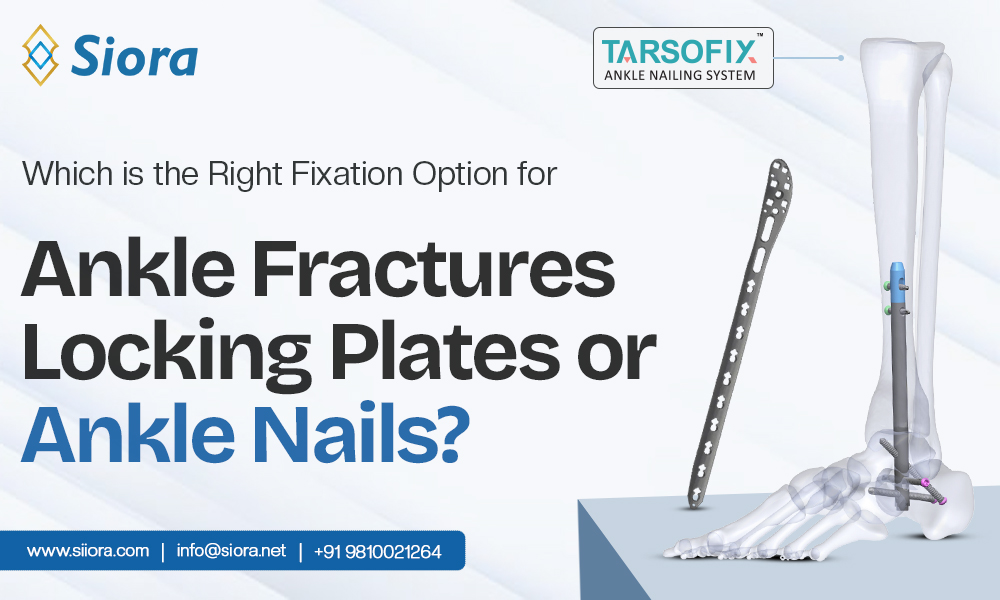
Fractures around the ankle are among the most common orthopedic injuries encountered in trauma care. Whether caused by road accidents, sports injuries, or falls, these fractures often require surgical intervention to restore alignment and enable early mobility. Among the various fixation options available, locking plates and ankle nails have emerged as two widely used solutions. However, choosing between these fixation methods depends on several factors, including fracture type, patient profile, bone quality, and surgeon preference.
What is Locking Plate Fixation?
Locking plates are specially designed implants that stabilize fractured bone segments using locking screws. Unlike conventional plates, these systems create a fixed-angle construct, offering enhanced stability, particularly in osteoporotic or comminuted fractures.
The use of locking plates has significantly improved outcomes in complex ankle fractures. Since the screws lock directly into the plate, the construct functions as a single unit, minimizing the risk of screw loosening and loss of reduction.
Advantages of Locking Plates
- Provide excellent anatomical reduction in complex fracture patterns.
- Offer strong fixation in osteoporotic bone.
- Enable stable fixation even in multifragmentary fractures.
- Available in precontoured designs that match ankle anatomy.
- Allow surgeons to address fractures involving the distal tibia and fibula with precision.
Because of these advantages, locking plates are often preferred for younger, active patients and fractures requiring accurate restoration of joint surfaces.
What Are Ankle Nails?
Ankle nailing systems are intramedullary devices that are inserted through the calcaneus and extended into the tibia. These implants are primarily designed for ankle fusion procedures and selected fracture cases, especially in elderly patients.
In recent years, ankle nails have gained popularity due to their minimally invasive approach and ability to facilitate early weight-bearing.
Benefits of Ankle Nails
- Require smaller incisions compared to plate fixation.
- Reduce soft tissue disruption around the ankle.
- Promote earlier mobilization and weight-bearing.
- Lower the risk of wound complications in vulnerable patients.
- Particularly beneficial in patients with poor bone quality or compromised soft tissues.
For elderly individuals or patients with diabetes and severe osteoporosis, ankle nailing may offer a safer alternative to traditional plating techniques.
Factors Influencing Implant Selection
Selecting the appropriate fixation method is rarely straightforward. Surgeons evaluate multiple clinical factors before making a decision.
1. Fracture Configuration
Simple fractures with minimal comminution may be effectively treated using locking plates. Conversely, highly unstable fractures in frail patients may be better managed with ankle nails.
2. Bone Quality
Patients with osteoporosis often present fixation challenges. Although locking plates perform well in weak bone, ankle nails can provide additional load-sharing support and facilitate immediate stability.
3. Soft Tissue Condition
Severe swelling, compromised skin, or open injuries increase the risk of wound-related complications. Since ankle nailing requires less soft tissue dissection, it may be advantageous in such cases.
4. Patient Age and Functional Demand
Younger and more active patients generally benefit from anatomical reconstruction achieved through locking plates. Older patients with limited mobility may experience improved recovery with ankle nail fixation.
Which Option Is Better?
There is no universal answer to this question. Both locking plates and ankle nails have distinct indications and clinical advantages. The ideal fixation method should be tailored to the patient’s anatomy, fracture characteristics, medical condition, and rehabilitation goals.
Modern orthopedic trauma care increasingly emphasizes individualized treatment planning rather than a one-size-fits-all approach. With continuous advancements in implant technology, both locking plate systems and ankle nailing devices continue to play essential roles in achieving successful patient outcomes.
Final Thoughts
Choosing between locking plates and ankle nails is a critical surgical decision that can directly influence recovery, mobility, and long-term function. Careful assessment of fracture complexity, patient health status, and soft tissue condition helps surgeons determine the most suitable fixation strategy. Ultimately, the right implant is the one that offers optimal stability while supporting safe and effective healing.

