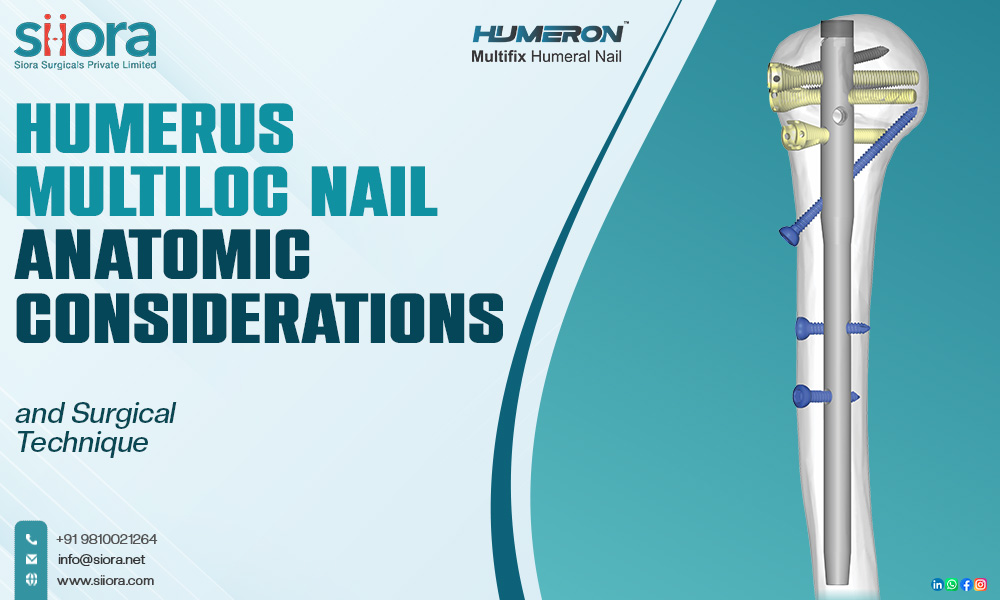
Fixing fractures of the humerus has always been a challenge for orthopedic surgeons. Unlike fractures in weight-bearing bones, injuries in the upper arm demand solutions that balance stability with mobility. The humerus multiloc nail has become one of the go-to implants in recent years because it respects the natural anatomy of the bone while allowing multiple locking options to secure different types of fractures.
A Quick Look at the Anatomy
The humerus stretches from the shoulder down to the elbow. It sounds straightforward, but every region has unique features that matter when operating.
- At the top end, the round head connects with the shoulder joint. Just below lie the greater and lesser tuberosities—key points where rotator cuff muscles attach. Damaging these during surgery may cause long-term stiffness.
- The shaft is not uniformly wide. It narrows and curves, making it tricky to place an implant without tailoring it to the bone’s shape. The multiloc nail was specifically designed with this in mind.
- Along the back of the bone, the radial nerve winds its way around. Surgeons must always be mindful of this; one wrong drill hole could lead to nerve palsy and wrist drop.
- At the bottom end, where the humerus meets the elbow, the shape becomes irregular and narrow. If the nail is too long, it could irritate or even enter the joint.
Why This Nail Over Older Implants?
Plate fixation once dominated humeral fracture treatment. While effective in certain cases, plates required larger incisions, more soft tissue stripping, and often longer recovery. The multiloc nail is gentler. Because it’s inserted through a much smaller opening, recovery is quicker. Its curved design matches the humerus, reducing the risk of malalignment.
Importantly, the nail locks with screws placed in several planes. This prevents both rotation and bending, which are common problems in humeral fractures due to constant muscle pull.
Planning is Half the Battle
Before surgery even begins, the surgeon studies X-rays to pinpoint the fracture pattern, canal size, and the suitable nail length. The patient is usually positioned supine on a radiolucent table. While this sounds routine, experienced surgeons know that proper setup often saves more time than any step of the actual surgery.
The Surgical Technique, Step by Step
Here’s how the procedure unfolds in most cases:
- Positioning – The patient lies on their back with the arm free to move. This allows clear fluoroscopic imaging throughout.
- Finding the entry point – The incision lies near the humeral head, careful not to disturb rotator cuff attachments. Preserving these muscles helps with faster functional recovery.
- Preparing the canal – A guidewire is slid into place under imaging. Reaming is generally light; aggressive reaming can weaken the bone shaft.
- Inserting the nail – The multiloc nail slides down the canal, its curve matching the bone’s natural path. Surgeons often remark that it “fits in smoothly when the entry point is just right.”
- Locking with screws – Depending on the fracture, one or several screws are inserted at both ends. Complex, multi-fragment fractures usually require more secure locking.
- Closure – Soft tissues are closed carefully. Minimal dissection means smaller scars and less muscle trauma.
After Surgery: Recovery Matters
Unlike older orthopedic implants, the multiloc nail supports early movement. Within days, patients may begin gentle pendulum exercises for the shoulder. This not only maintains motion but also speeds pain relief. Follow-up radiographs ensure the fracture is healing and the implant remains in place. Most patients regain useful function within months, provided physiotherapy is consistent.
Final Word
The multiloc humerus nail has changed how surgeons approach humeral fractures. It combines anatomical precision, multiple locking options, and a minimally invasive technique. When paired with thoughtful planning and diligent rehabilitation, it offers patients a faster, more predictable road back to mobility. While no implant is perfect, the multiloc nail stands out for how well it balances stability with respect for the bone’s natural design.

